Scripts & Alphabets
The Phoenician Origins of Alphabets: How One Script Changed the World
Explore how the ancient Phoenician alphabet became the ancestor of almost every alphabet used today.
15 min read0
AM
Amira Hassan
Linguist and typographer specializing in Arabic script history and evolution.
Introduction
Imagine a world without alphabets. Writing would require memorizing thousands of symbols—one for each word or concept, like ancient Egyptian hieroglyphs or Chinese characters. This was the reality for most of human history until a group of ancient traders had a revolutionary idea.
Around 1050 BCE, the Phoenicians—master merchants of the ancient Mediterranean—developed a writing system so efficient that it would become the ancestor of nearly every alphabet used today. From the Arabic script flowing right-to-left across Middle Eastern newspapers to the Latin letters you're reading right now, the family tree traces back to those Phoenician traders in ancient Lebanon.
This is the story of how one simple innovation changed human communication forever.
The Pre-Alphabetic World
Writing Before Alphabets
Before the Phoenician revolution, the ancient world used several writing systems:
Cuneiform (Mesopotamia)
- Developed around 3400 BCE in Sumer
- Used wedge-shaped marks pressed into clay
- Originally pictographic, evolved to represent syllables
- Required learning 600-1000 signs
Egyptian Hieroglyphs
- Developed around 3200 BCE
- Combined logographic and alphabetic elements
- Required learning several hundred signs
- Mostly limited to priestly and scribal classes
Chinese Characters
- Developed around 1200 BCE (possibly earlier)
- Each character represents a word or morpheme
- Requires learning thousands of characters
- Still in use today
The Literacy Problem
These complex writing systems created a fundamental barrier: literacy was restricted to specialists who spent years mastering hundreds or thousands of signs. Writing was a technology of the elite—priests, scribes, and administrators.
The Phoenicians would change this forever.
The Phoenicians: Merchants of the Mediterranean
Who Were the Phoenicians?
The Phoenicians were a Semitic-speaking people who inhabited the coastal cities of ancient Lebanon (Tyre, Sidon, Byblos, and Beirut) from around 1500-300 BCE. Though they called themselves Canaanites, the Greeks named them "Phoenicians" (Φοίνικες), likely referring to their famous purple dye industry.
The Phoenicians were the great traders of the ancient Mediterranean:
- Established trading posts across the Mediterranean
- Founded Carthage (in modern Tunisia)
- Traded in purple dye, cedar wood, glass, and metalwork
- Created extensive maritime networks
Why the Phoenicians Needed a Better System
For merchants, efficient record-keeping was essential:
- Tracking shipments and inventories
- Recording transactions and debts
- Communicating with trading partners
- Training new employees quickly
The complex writing systems of their neighbors were impractical for commercial use. The Phoenicians needed something simpler—something that could be learned quickly and used efficiently.
The Phoenician Innovation
The Alphabet Principle
The Phoenicians' breakthrough was the acrophonic principle: each symbol represents a single consonant sound, derived from the first sound of the word the symbol originally depicted.
For example:
- Aleph (𐤀): Originally an ox head → represents /ʔ/ (glottal stop)
- Beth (𐤁): Originally a house → represents /b/
- Gimel (𐤂): Originally a camel/throwing stick → represents /g/
- Daleth (𐤃): Originally a door → represents /d/
This created a system of just 22 consonant letters—dramatically simpler than any previous writing system.
The Complete Phoenician Alphabet
Letter  Name       Sound   Original Meaning
𐤀      Aleph      ʔ       Ox
𐤁      Beth       b       House
𐤂      Gimel      g       Camel/Throwing stick
𐤃      Daleth     d       Door
𐤄      He         h       Window/Jubilation
𐤅      Waw        w       Hook
𐤆      Zayin      z       Weapon
𐤇      Heth       ḥ       Fence/Courtyard
𐤈      Teth       ṭ       Wheel/Snake
𐤉      Yodh       y       Hand/Arm
𐤊      Kaph       k       Palm of hand
𐤋      Lamedh     l       Goad
𐤌      Mem        m       Water
𐤍      Nun        n       Fish/Snake
𐤎      Samekh     s       Fish/Support
𐤏      Ayin       ʕ       Eye
𐤐      Pe         p       Mouth
𐤑      Tsade      ṣ       Fishhook/Plant
𐤒      Qoph       q       Monkey/Needle eye
𐤓      Resh       r       Head
𐤔      Shin       š       Tooth
𐤕      Taw        t       Mark/Cross
What Made It Revolutionary
- Simplicity: Only 22 symbols to learn
- Phonetic: Represented sounds, not concepts
- Flexibility: Could write any word in the language
- Learnability: Could be mastered in weeks, not years
- Portability: Simple symbols easy to write on any surface
The Spread of the Alphabet
The Western Branch: Greek and Latin
Around 800 BCE, the Greeks adopted the Phoenician alphabet, making crucial modifications:
Greek Innovations:
- Added vowel letters (using Phoenician consonants their language didn't need)
- Aleph (ʔ) → Alpha (A)
- He (h) → Epsilon (E)
- Yodh (y) → Iota (I)
- Ayin (ʕ) → Omicron (O)
- Created new letters for sounds Phoenician lacked
The addition of vowels was transformative—Greek became the first "true alphabet" representing both consonants and vowels.
From Greek, the alphabet spread to:
- Etruscan → Latin → Most European languages
- Cyrillic → Russian, Ukrainian, Bulgarian, Serbian
- Coptic → Ancient Egyptian language
- Gothic → Ancient Germanic languages
The Eastern Branch: Aramaic and Arabic
The Aramaic alphabet, closely related to Phoenician, became the writing system of the Aramaic language—the lingua franca of the ancient Near East.
From Aramaic descended:
- Hebrew script
- Nabataean → Arabic script
- Syriac scripts
- Pahlavi → foundation for some Central Asian scripts
The Arabic Connection:
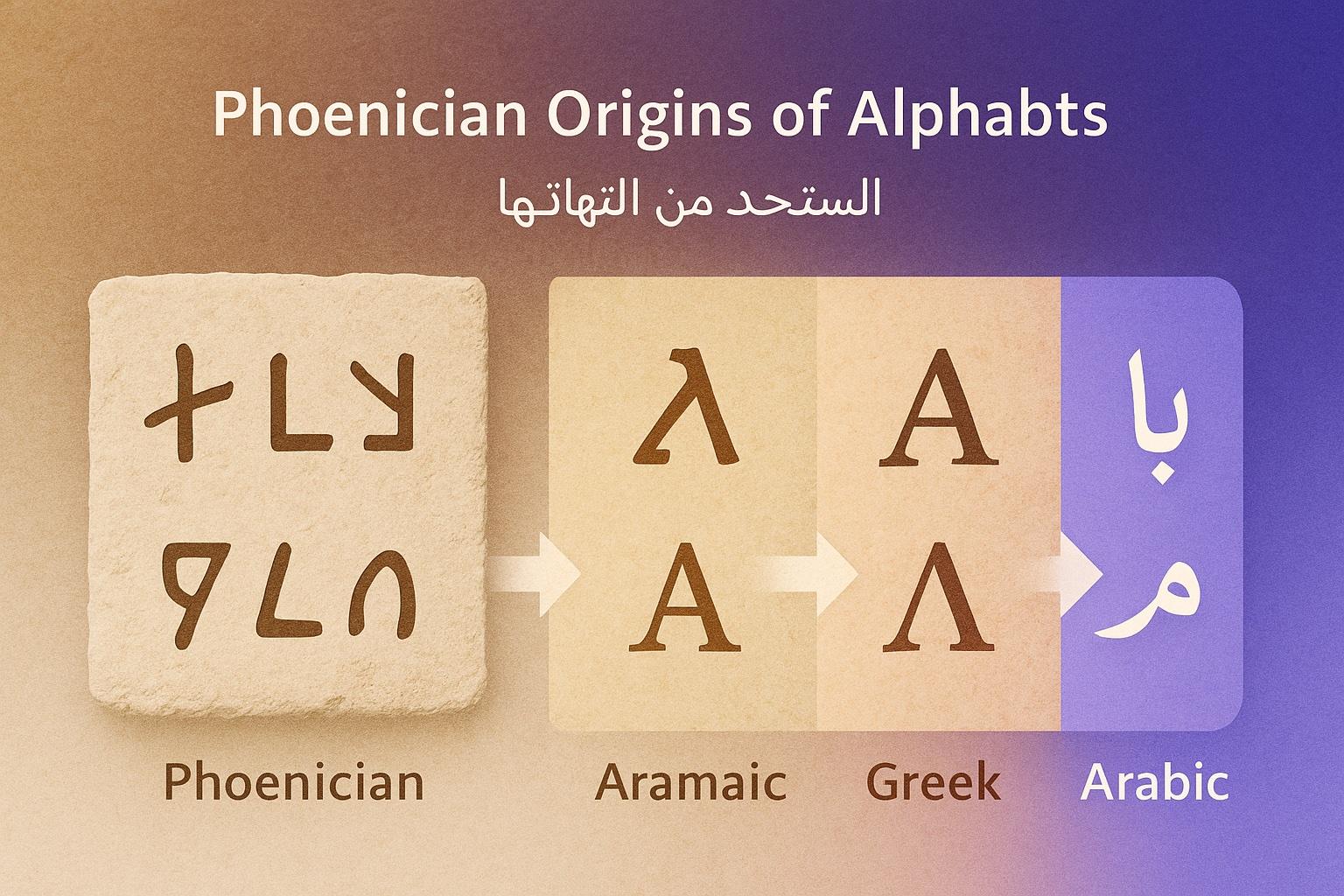
The Arabic script's journey from Phoenician:
Phoenician → Aramaic → Nabataean → Arabic
(1050 BCE)   (850 BCE)  (150 BCE)   (400 CE)
The South Asian Branch
The Brahmi script of ancient India, ancestor of Devanagari, Tamil, Thai, Tibetan, and many other scripts, likely also derived from a Semitic alphabet, though the exact transmission route is debated.
This means scripts used by billions of people across South and Southeast Asia may share the Phoenician heritage.
The Family Tree Today
Scripts Descended from Phoenician
Western Branch (via Greek):
- Latin (English, French, Spanish, German, etc.)
- Cyrillic (Russian, Ukrainian, Bulgarian)
- Georgian
- Armenian (disputed)
Eastern Branch (via Aramaic):
- Hebrew
- Arabic
- Syriac
- Mandaic
South Asian Branch (possibly via Aramaic):
- Brahmi → Devanagari (Hindi, Sanskrit)
- Tamil, Telugu, Kannada, Malayalam
- Thai, Lao, Khmer, Burmese
- Tibetan
What About Chinese, Japanese, Korean?
Chinese characters developed independently and are not descended from Phoenician.
However:
- Japanese uses Chinese characters (kanji) alongside syllabic scripts (hiragana, katakana)
- Korean Hangul was deliberately designed in the 15th century as an original system
- Both languages heavily use loanwords written in adapted scripts
RTL and LTR: Why Do Writing Directions Differ?
The Phoenician Direction
Phoenician was written right-to-left (RTL), likely because:
- Most people are right-handed
- Carving on stone from right to left prevents the hand from covering fresh work
- Earlier Semitic scripts used RTL
The Greek Switch
Early Greek used boustrophedon writing—alternating directions line by line (like an ox plowing a field). Eventually, Greeks standardized on left-to-right (LTR), possibly because:
- Writing with ink (rather than carving) favors LTR for right-handed writers
- The writing hand doesn't smear fresh ink
The Split Inheritance
This directional split explains today's divide:
- RTL scripts: Arabic, Hebrew, Syriac (Aramaic heritage)
- LTR scripts: Latin, Greek, Cyrillic (Greek heritage)
Both directions trace back to the same Phoenician source—a fascinating example of how writing systems evolve differently in different cultural contexts.
The Legacy of Phoenician
Democratization of Literacy
The simple alphabet made literacy achievable for ordinary people. While cuneiform and hieroglyphs required years of specialized training, alphabetic writing could be learned quickly—transforming who could read and write.
Enabling Innovation
Accessible writing enabled:
- Record-keeping for commerce and government
- Literature accessible to wider audiences
- Scientific and philosophical writing
- Religious texts available to believers
- Democratic governance (written laws, voting)
A Shared Heritage
When an English speaker reads these words, an Arabic reader studies the Quran, or a Hindi speaker texts in Devanagari, they're all using systems that trace back to those innovative Phoenician merchants.
This shared heritage reminds us that writing—like language itself—is a fundamentally human achievement that transcends cultural boundaries.
Key Takeaways
-
Revolutionary simplicity: The Phoenician alphabet reduced writing from hundreds of symbols to just 22, democratizing literacy.
-
The acrophonic principle: Each letter represented a sound derived from the first sound of a word it depicted (aleph/ox → /ʔ/).
-
Two main branches: Western (Greek → Latin, Cyrillic) and Eastern (Aramaic → Hebrew, Arabic) descended from the same source.
-
Direction divergence: RTL scripts (Arabic, Hebrew) and LTR scripts (Latin, Greek) both trace back to Phoenician's RTL writing.
-
Global impact: Nearly every alphabet used today descends from this single innovation by ancient Mediterranean traders.